Spectral Reconstruction with Optimized Stereo Cameras
University of Milano-Bicocca
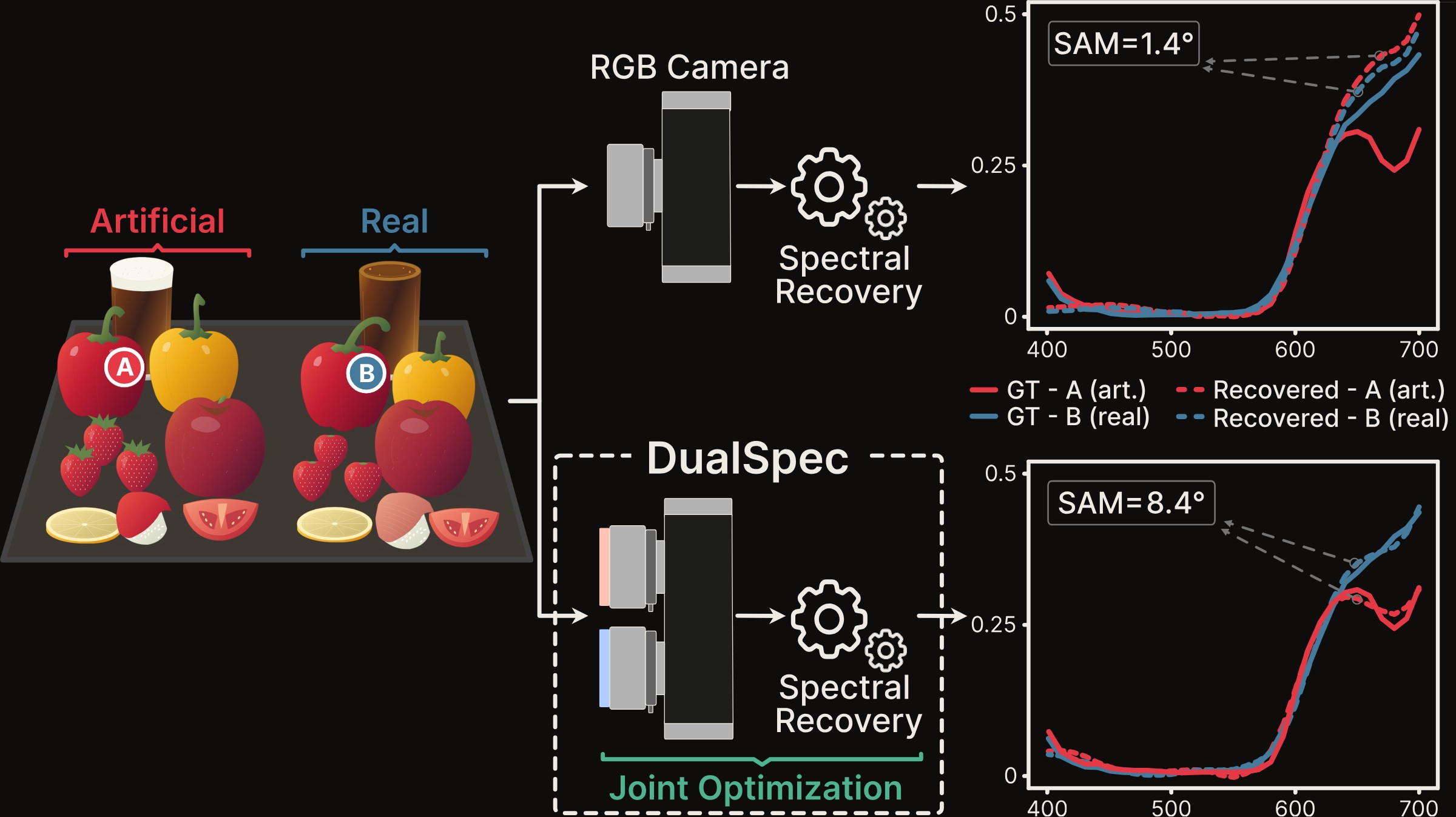
Method
Step through the training pipeline, or click a part of the figure.
Spectral camera playground
Build your spectral camera: assemble two acquisition systems and compare what their reconstruction networks recover. Every option is a trained model from the paper, tested on the same images with the same simulated sensor noise.
Reconstruction error RMSE × 1000 per pixel
Drag the handle to compare. Click to pin a pixel.
Spectra at the marked pixel
Loading scene…
Results on Arad-1K and BGU-ICVL
Test-set results of the paper, as a chart or as the full table. SAM in degrees and RMSE × 1000 (lower is better), PSNR in dB (higher is better). In the tables, bold marks the best value for each network and statistic.
Displaced views and new datasets
Do the learned filters and networks work beyond their training data, and with two cameras that really are in different places? We test the models trained on Arad-1K, without fine-tuning, on our displaced-view benchmark and on CAVE.
Displaced-view benchmark
Ten scenes captured twice with a Specim IQ hyperspectral camera, 2 cm apart, as the two cameras of a stereo rig would see them. The two simulated views are registered before reconstruction.
Results on displaced views and CAVE
From learned curves to real filters
A learned transmittance is only useful if it can be manufactured. We fit each attachment with a conventional interference filter: 30 layers alternating Ti3O5 and SiO2 on glass, each 10–400 nm thick. Then we check what the swap costs the reconstruction, and how much of it fine-tuning wins back.
3 steps Go through them in order. Each one fills a row of the table with the paper's results.
Transmittance attachment 1
Layer stack thickness of each layer, light enters on the left
Thin-film results for every network
BibTeX
@article{cogo2026dualspec,
  title   = {DualSpec: Spectral Reconstruction with Optimized Stereo Cameras},
  author  = {Cogo, Luca and Buzzelli, Marco and Bianco, Simone and Schettini, Raimondo},
  journal = {arXiv preprint arXiv:XXXX.XXXXX},
  year    = {2026}
}